Herts Ability Is Proud to Support Stroke Prevention Day 2026

Raising awareness. Sharing hope. Restoring independence.
On Thursday 29 January 2026, Herts Ability is proud to support Stroke Prevention Day, a vital national awareness day that reminds us how many strokes can be prevented - and how life-changing the impact of stroke can be.
Stroke remains one of the leading causes of disability in the UK. One of the most important messages this year is that high blood pressure is the single biggest risk factor for stroke - and often has no obvious symptoms. The simple act of checking your blood pressure regularly could save your life or the life of someone you love.
Why blood pressure checks matter
We are encouraging everyone to have their blood pressure checked regularly, whether at a GP surgery, pharmacy or at home. If high blood pressure is identified early, there are many ways to bring it down and significantly reduce the risk of stroke.
Simple lifestyle changes can make a powerful difference, including:
- Eating a healthy, balanced diet
- Staying physically active
- Reviewing alcohol consumption
- Stopping smoking or vaping
Stroke Prevention Day is about awareness, but it’s also about action. By sharing our messages and images on social media, you can help encourage more people to check their blood pressure - and the more people who act, the more strokes we can prevent.
Independence after stroke: Karen’s story
As we mark Stroke Prevention Day, we are also absolutely delighted to share another inspiring success story from Herts Ability - a story that shows not only the devastating impact stroke can have, but also the incredible resilience of stroke survivors and the power of the right support!
Huge congratulations to Karen, who has now been formally assessed by Herts Ability and confirmed fit to drive, regaining an independence that once felt uncertain.
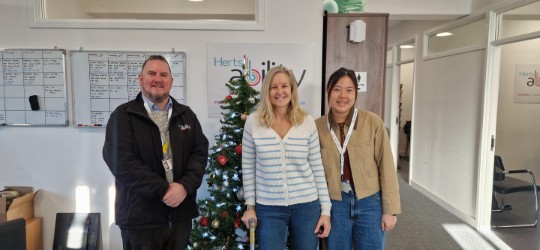
Karen is pictured celebrating this milestone with Charis, Occupational Therapist, and Simon, Lead Driving Assessor (Driving Instructor). It’s a moment that represents far more than a return to driving - it marks an extraordinary journey of recovery, determination and hope.
“What an end to 2025!” Karen says. “I passed my Herts Ability driving assessment and I’m safe to drive again after five long months.”
For Karen, driving has always meant freedom. Living in a village and having driven for over 40 years, being behind the wheel was central to her independence and daily life.
But in 2025, everything changed.
A life changed in an instant
Karen, a teacher, had been looking forward to her summer holidays as usual. Just a week after climbing Snowdon, she travelled to Croatia with friends. On the second day of her holiday, she suffered a massive cerebellar stroke.
“I couldn’t walk, I couldn’t see, I was constantly being sick and I had huge gaps in my memory,” Karen explains.
She spent two weeks in a Croatian hospital before being flown home with a doctor. While trying to re-enter the UK healthcare system, Karen then experienced a TIA, resulting in another hospital stay.
At that point, Karen could walk slowly using a zimmer frame, veering to the left, and her left eye had been damaged. The road ahead felt daunting.
A journey of recovery, perseverance and support
Karen’s recovery involved an extensive multidisciplinary team, including occupational therapists, physiotherapists, eye specialists and a psychologist - all working together to help her rebuild her life.
“They helped me relearn how to walk using just a stick, move my head without looking like a tin soldier, correct my vision, manage enormous fatigue and begin to live again - albeit differently,” she says.
Karen credits her progress to following professional advice closely and refusing to give up, even during moments of deep frustration.
“I cried a lot, but I kept going.”
By the end of November, her occupational therapist felt she might be ready for a driving assessment with Herts Ability - an idea that brought mixed emotions.
“I was nervous and excited at the same time. Driving is vital to my independence, but I didn’t just want to drive again - I wanted to know I was safe. The last thing I ever wanted was to hurt someone or cause an accident.”
A supportive, reassuring driving assessment
From the moment Karen arrived at Herts Ability, she felt supported and reassured.
“The team were amazing. Everything was done at my pace, and they were very clear this wasn’t a driving test - it was an assessment to make sure I was safe.”
Karen completed cognitive assessments over coffee before heading out into a dual-controlled vehicle with Simon. Starting in a quiet residential area allowed her to rebuild confidence after months away from driving.
“I felt safe. We took things slowly, and I had time to familiarise myself with the car.”
As the drive progressed into busier town environments, Karen noticed both her confidence growing and her limits.
“I asked for a rest because the sensory overload was a bit much. We sat in the car for five minutes, talking through what I’d just done - navigating pedestrians, cars, motorbikes and lots of left and right turns.”
Once ready, Karen continued onto faster roads, discussed road signs and safely returned to the Herts Ability centre.
“The whole time, I was reassured and made to feel completely at ease.”
“I’ve been given a second chance at life”
“At the tender age of 58, I’m a young stroke survivor,” Karen reflects. “But I’m determined not to let this shape my life or control me.”
She was told the first six months after a stroke are critical for recovery, and she embraced every opportunity for support.
“My advice to anyone going through something similar is to take all the help you can - including Herts Ability. This is an amazing service, and it was free for me following an OT referral.”
The moment Karen was told she was fit to drive again was life-changing.
“It felt incredible to drive to the chemist and pick up my own prescription. That might sound small, but it meant everything.”
Thank you, Karen, for sharing your story!
“Thank you, Herts Ability, for your care, compassion, understanding and positivity. You’ve given me back my independence and the confidence that I am safe on the road.”
Karen’s journey is a powerful reminder that with the right support, independence doesn’t have to end after illness or injury - it can begin again!
Driving assessments following a stroke
After a stroke, people are legally required to stop driving for a minimum of one month. For many individuals, this is only the beginning of recovery, and a much longer period may be needed before driving can be considered again. The timescale depends on the severity of the stroke and the effects it has caused.
Common effects of stroke may include:
- Physical effects: weakness or paralysis (often on one side), reduced balance, sensation or coordination
- Vision changes: blurred vision, double vision or visual field loss
- Cognitive changes: difficulties with memory, concentration, spatial awareness, problem-solving or insight
- Psychological impact: anxiety, reduced confidence, low mood or frustration
Many physical difficulties can be accommodated through vehicle adaptations, such as steering aids or left-foot accelerators. Our assessments explore these options where appropriate.
However, some conditions make driving unsafe. Perceptual inattention or neglect, certain visual field defects, and uncontrolled seizures are considered debarring conditions, and the DVLA may revoke a driving licence in these cases.
Driving is not permitted if seizures are present until they are fully controlled and the person has been seizure-free for at least one year. Cognitive changes are also common after stroke, which is why cognitive testing forms an essential part of the driving assessment process.
Anyone experiencing ongoing difficulties one month after a stroke should discuss these with their doctor or occupational therapist. If lasting effects may impact driving ability, there is a legal requirement to inform the DVLA (or DVA in Northern Ireland) before returning to driving.
Need help getting back on the road?
If you or someone you know needs support to:
- Regain driving confidence
- Return to driving after illness or injury
- Explore vehicle adaptations
Our friendly, experienced team is here to help.
Try driving with adaptations
We offer the opportunity to explore a wide range of vehicle adaptations and transfer aids. Our dual-controlled fleet is fully equipped to help you find what works best for you.
📞 Call: 01707 324 581
📧 Email: driving@hertsability.org.uk
By raising awareness and providing specialist support, Herts Ability is proud to play a part - not just in preventing strokes, but in helping people rebuild their lives afterwards.
Together, we’ll help make independence possible!
Together, let’s prevent strokes and support survivors!
Together, we can make a difference!